Quantum Treasure Hunt
Grover's search as a game: a classical player opens chests one by one while a real IBM quantum chip's measurements boost the right one.
Downloads 31 kB on demand
- Next query
- One query for each player
- Auto-play
- Run the race on a timer
- Measure now
- Open a chest as the quantum player
- Built
- Stack
- Python, Qiskit, IBM Quantum, TypeScript, Vite
How it works
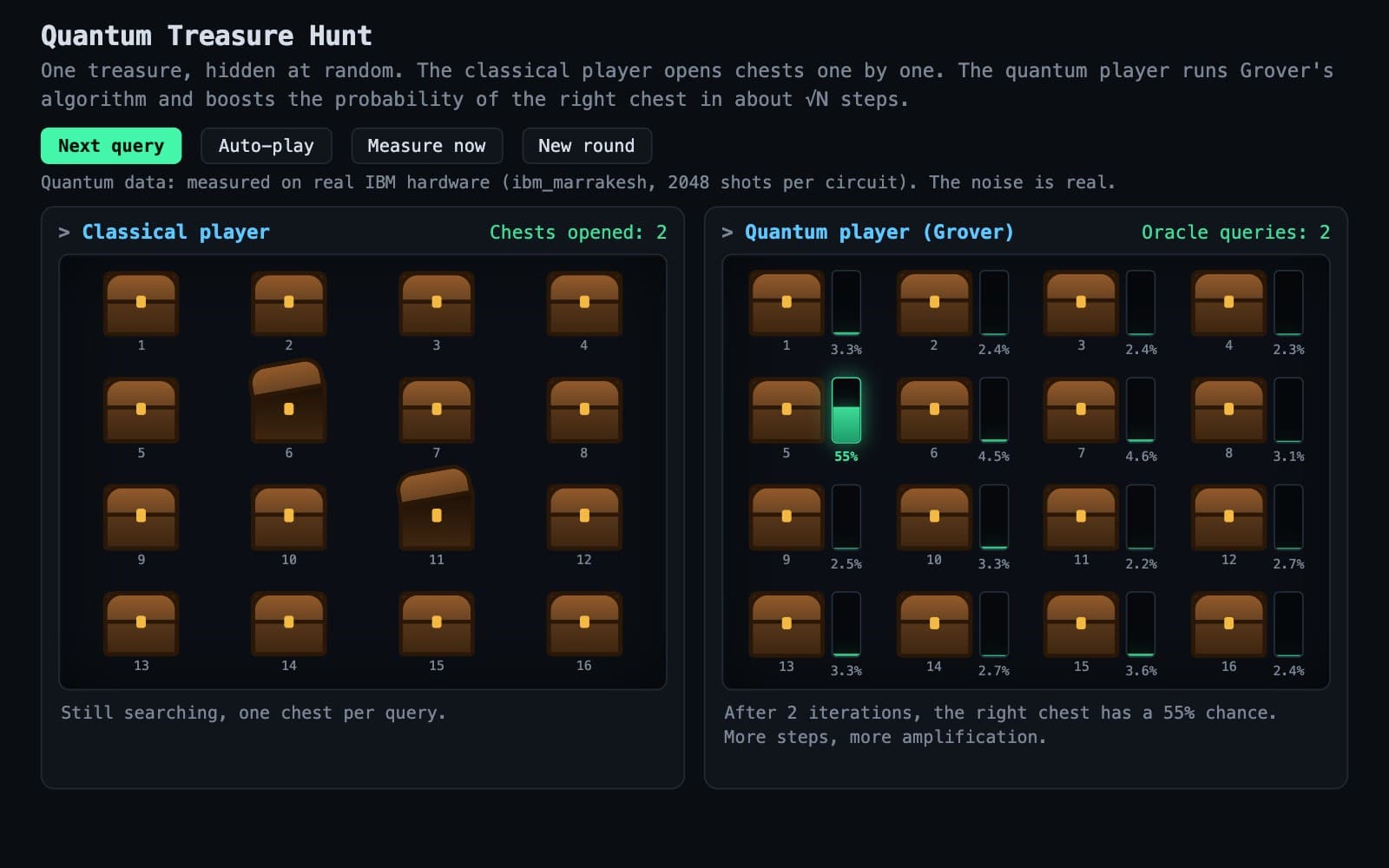
One treasure is hidden at random among 16 chests. The classical player opens them one at a time; the quantum player applies Grover iterations, and the right chest's probability climbs with each one until it is measured. Both are charged in oracle queries, one per chest opened against one per Grover iteration, so the race is fair. The quantum side is not an animation: every treasure position was run once on IBM's ibm_marrakesh in a single batched job, and the game replays the saved counts. A real chip is noisy, so with 16 chests the treasure peaks near 51% after two iterations instead of the ideal 91%, and the third iteration makes it worse. It is still the tallest bar every time. As a game-dev takeaway, there is no use for this in games today: Grover needs unstructured search, and games have grids and trees.